
India successfully conducted the third developmental trial in four days of its indigenously developed beyond visual range air-to-air missile 'Astra' on Monday from the integrated test range at Chandipur, 15 km from Balasore in Odisha.

The HSTDV is an unmanned scramjet demonstration aircraft for hypersonic speed flight, it can cruise at a speed of mach 6 and move up to an altitude of 32.5 km (20 miles) in 20 seconds, the sources said.
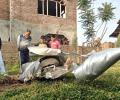
'There is no independently verified imagery or battlefield evidence to support Pakistan's claim.'

A lot of new technologies developed indigenously were successfully tested in the trial.
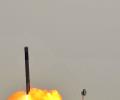
India on Tuesday test-fired an advanced version of the 290-km range BrahMos supersonic cruise missile from the Odisha coast. The missile was test-fired from a mobile launcher from the Integrated Test Range at Chandipur at about 10.40 am, Defence Research and Development Organisation said.

While MBBS continues to be the most sought-after stream for medical aspirants, post pandemic, the demand for skilled nurses and physiotherapists are on the rise, notes Nayagam PP, career counsellor and founder of EduJob360.

India on Friday successfully test-fired its indigenously-developed nuclear-capable Prithvi-II and Dhanush ballistic missiles in separate trials, boosting the armed forces' operational readiness.
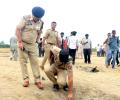
Indian Armed Forces brought down a number of these drones using kinetic and non-kinetic means.

India has reported 59 cases of Human Metapneumovirus (HMPV) and two deaths due to co-morbidities between January 6 and 29, according to Union Minister Prataprao Jadhav. The virus primarily affects young children, the elderly, and immunocompromised individuals, leading to respiratory illnesses. The government has taken measures to monitor and control the spread of HMPV cases and create public awareness.

India on Monday test-fired its nuclear-capable Agni-III ballistic missile with a strike range of more than 3,000 km as part of a user trial by the Army from Wheeler Island off Odisha coast, defence sources said.

The state-of-the-art advanced missile, a product of joint venture between India and Israel.

rediffGURU Rajiv Kovil, a senior diabetologist and obesity specialist, offers advice on how you can alter your diet and lifestyle to maintain healthy sugar levels.

It was the third user trial in the Agni-III series carried out to establish the repeatability of the missile's performance.
Prithvi has already been inducted into the Army and Wednesday's test involved one of the products picked up at random from the assembly line.

Prithvi-2 is capable of carrying 500-1,000 kg of warheads and is powered by liquid propulsion twin engines, the sources said.

The missile positioned at launch pad-3 of the ITR swung in to action after getting signal from the radars to intercept a moving aerial target supported by an unmanned air vehicle (UAV) 'Banshee' over the Bay of Bengal, officials said.

The missiles were randomly chosen from the production stock and the entire launch activities were carried out by the specially formed strategic force command and monitored by the scientists of Defence Research and Development Organisation as part of training exercise, a defence scientist said.

Numeros Motors is also planning to come up with a passenger vehicle four-wheeler or a three-wheeler by 2027.
The missile, which has a launch weight of 700 kg, can carry a warhead of 60 kg and operated in conjunction with a Rajendra surveillance and engagement radar being developed by the Electronic Research and Development Establishment.

The indigenously made Agni V missile was test-fired from off the Odisha coast.
The missile, weighing 650kg, can carry a 50kg payload over a distance of 25km.
This is the first time Agni-III has been test-fired.
The missile has a strike range of 2000 km, the sources said soon after it blasted off from a mobile launcher at the Launch Complex-4 of the Integrated Test Range, the sources said.

ISRO's Thiruvananthapuram-based Vikram Sarabhai Space Centre successfully conducted a series of drogue parachute deployment tests at the rail track rocket sled facility of the Terminal Ballistics Research Laboratory in Chandigarh during August 8-10.
The ground range instrumentation from ITR and the radar located near the impact point tracked the missile trajectory and monitored all the parameters from launch, the source said.

A salvo from a Pinaka battery brings down on the enemy more than seven tonnes of high explosive in just 44 seconds.

HAL has integrated the ASRAAM (advanced short range air-to-air missile) for the Tejas Mark 1A. The Tejas Mark 1A will carry twin ASRAAM missiles with a range of 60 to 70 kilometres.
India's nuclear-capable, surface-to-surface Agni-II ballistic missile, with a strike range of 2,000 kms, was on Friday test-fired as part of user trial by the army from the Wheeler Island off Orissa coast.
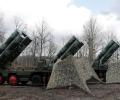
The exercise was conducted by the Indian Air Force to showcase full integration of air defence missile system into the force, they said.

It was for the first time that the missile, capable of travelling at speeds of up to Mach 3.0, or three times the speed of sound, was tested with indigenously developed 'seeker' technology.

Rishabh Pant has been nominated for the prestigious Laureus World Comeback of the Year Award.

Like the Shourya and Prahar missiles, the Pralay is powered by conventional solid fuel, and its payload is designed to carry only a conventional warhead.

Human Metapneumovirus (HMPV) is a respiratory virus that causes illnesses ranging from mild respiratory discomfort to severe complications. It spreads through respiratory droplets, similar to other respiratory viruses such as RSV and influenza. This article provides an overview of HMPV including its symptoms, transmission, prevention, diagnosis, treatment, and how it differs from COVID-19.
'In today's launch, the 'Pralay' missile was tested for heavier payload and different range to prove the precision and lethality of the weapon'

The counselling session was likely to begin in the first week of July. However, the counselling authorities had not notified any date or schedule.

India has tested a 1,000 kg indigenously-developed glide bomb, which successfully hit a target 100 km away, in the Bay of Bengal off the Odisha coast, making the country self-reliant in guided precision bombs.

Although the credit for acquiring the technological skill must be given to India's outstanding nuclear scientists, the decision to go nuclear was a political one that entailed clarity of vision, courage and resolve, points out Rup Narayan Das.

The Centre on Monday advised states and union territories to screen and test of all suspect mpox cases.
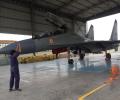
The integration of BrahMos with the Su-30MKI make the Indian Air Force the only air force in the world in procession of a supersonic cruise missile system.
The growing decline of MTech applicants in Indian colleges is due to multiple factors, including outdated curricula, poor return on investment and lucrative non-engineering alternatives, say experts.
